
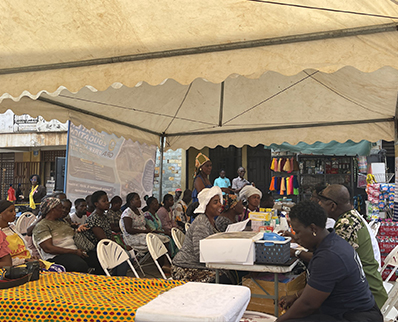
The Ghana Revenue Authority (GRA) has intensified its national tax education campaign, with an outreach at the Abeka-Lapaz market, sensitising traders on the newly introduced Modified Taxation Scheme (MTS).
The MTS is a simplified system designed to make tax payment easier and more convenient for informal sector taxpayers, which forms part of the Sustained Tax Education Programme (STEP), a three-year nationwide initiative being rolled out jointly by the Ministry of Finance and the GRA.
The programme aims to ensure that tax information reaches every segment of the population, including market traders, students, artisans, and business owners.
The event also saw free health screening organised by the GRA for the market women, traders, hairdressers, drivers, among others.
Speaking on behalf Mr Anthony Kwasi Sarpong, the Commissioner-General of GRA, Madam Elsie Appau-Klu, the Technical Advisor to the Commissioner General, said Ghana’s long-term development depended on the commitment of its citizens to pay the right taxes.
She said taxpayers’ dedication, even in challenging economic times, continued to support national progress but stronger collective effort was needed to achieve the country’s development goals.
Madam Appau-Klu said President John Dramani Mahama’s national “reset” agenda could only be driven in partnership with Ghanaians, noting that taxation remained central to building the modern infrastructure, markets, schools, and security services the country required.
“The Commissioner-General therefore encourages all taxpayers to stand up for Ghana, engage with Ghana, and pay their taxes,” she added.
The Technical Advisor said the “modern” GRA was committed to engaging taxpayers proactively instead of waiting for them to visit its offices.
She assured the public of transparency and accountability in the use of tax revenue, urging taxpayers to recognise their role in sustaining Ghana’s future.
Madam Appau-Klu cautioned that enforcement actions including sanctions and possible closure of businesses, would be taken against individuals and entities that consistently failed to comply with their tax obligations.
Mr Victor Akogo, the Coordinator of the MTS, said the Scheme offered an easy and convenient way to assess the business income of informal sector workers, ensuring wider tax inclusion and removing long-standing barriers to compliance.
He explained that the scheme began with a mandatory registration process, which had been simplified through a dedicated mobile application available on the Google Play Store.
“Taxpayers are required to register using their Ghana Card, phone number, business location or GPS address, and any relevant documents from the Office of the Registrar of Companies,” he added.
He said after registration, taxpayers were required to declare their turnover to determine the appropriate tax category.
The Coordinator said businesses operating below the equivalent of a 40-footer container size would pay a quarterly fixed tax of GH₵45, while larger traders such as those operating 40-footer containers would pay three per cent of their turnover as presumptive tax.
Tax payment under the MTS no longer required visits to GRA offices but could be made conveniently using the short code *880#, selecting the “Modified Taxation” option, and entering the Ghana Card number and desired payment amount.
Mr Akogo noted that nationwide sensitisation exercises had already led to significant registrations, but more individuals were needed to meet the national target of enrolling two million taxpayers, with field officers helping informal sector operators complete the registration process.
The Authority encouraged all eligible taxpayers to register and comply voluntarily, stating that the MTS was designed to make taxation simple, accessible, and fair for all.